Ertaul, L. S., “White Holes: From Quantum Remnants to Planck Stars — A Review”, The Columbia Junior Science Journal, 2025 (Semi-Finalist)
Abstract. White holes, the time-reversed counterparts of black holes, have reemerged in recent years as a serious topic of inquiry in quantum gravity. This review focuses on the framework developed by Carlo Rovelli and collaborators, who propose that black holes do not end in singularities but instead undergo a quantum bounce, transitioning into long-lived white hole remnants. Informed by Rovelli’s recent book White Holes (2023), his 2024 preprint with Vidotto on Planck stars and quasi-particles, and earlier collaborations with Bianchi and others, this review synthesizes a coherent theoretical framework that offers a possible resolution of the black hole information paradox. These studies suggest that quantum tunneling at the Planck scale prevents singularities, preserves unitarity, and allows information to be gradually released through the white hole phase. While direct observational evidence remains elusive, the coherence and mathematical clarity of Rovelli’s framework make it one of the most compelling proposals for the ultimate fate of black holes.
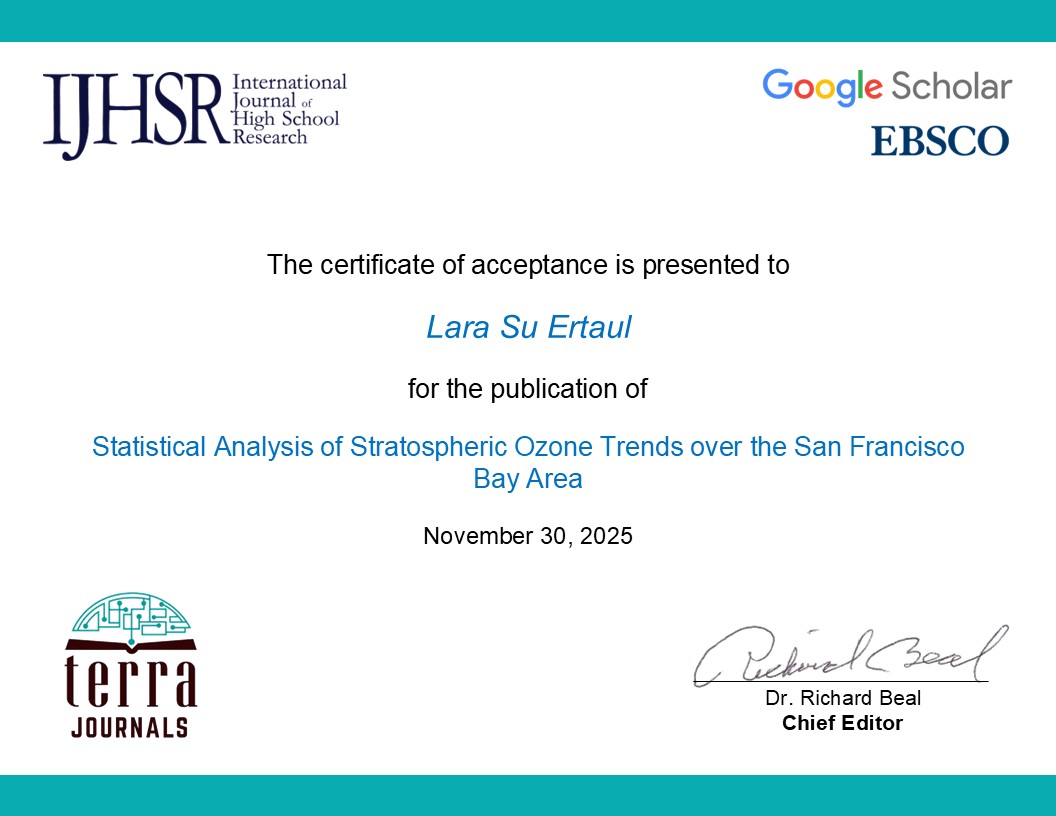
Ertaul, L. S., “Statistical Analysis of Stratospheric Ozone Trends Over The San Francisco Bay Area”, International Journal of High School Research (IJHSR), Vol 7, Issue 11, pp. 68-77, DOI: 10.36838/v7i11.68, 2025
Abstract. Stratospheric ozone plays a critical role in shielding life on Earth from harmful ultraviolet radiation. This study investigates ozone variability over the San Francisco Bay Area by applying a variety of statistical methods on NASA’s OMI OMTO3d (2004–2025) and OMPS NMTO3-L3_DAILY (2012–2025) datasets. Results revealed strong seasonal variation, with ozone levels peaking in April–May and dipping in October–November, consistent with Brewer-Dobson circulation and sunlight cycles. A gradual upward trend suggests gradual ozone recovery following the Montreal Protocol. Spectral analysis confirmed a dominant annual cycle. Solar influence was investigated using sunspot data from WDC-SILSO’s (World Data Center for Sunspot Index and Long-term Solar Observations) Northern Hemisphere records; however, Granger causality testing indicated a weak predictive relationship at short lags (p<0.07), but not significant under standard criteria (p<0.05) between sunspots and ozone levels. Cross-correlation analysis revealed a moderate association. This research provides new insights into regional ozone behavior and highlights the importance of continued localized monitoring.
EXECUTIVE SUMMARY
In this study, I analyzed stratospheric ozone trends over the San Francisco Bay Area using a suite of statistical techniques to assess ozone layer recovery and investigate contributing factors. My results reveal a gradual upward trend in ozone levels over time, suggesting a slow but steady recovery, and show evidence of a faint time-lagged correlation between solar activity, specifically sunspot cycles, and ozone variability.
I used satellite data from NASA’s Aura (OMI OMTO3d) and Suomi NPP (OMPS NMTO3-L3_DAILY) missions, applying linear regression, winsorization, rolling averages, and spectral analysis to detect seasonal trends and long-term behavior. A key finding emerged when I discovered a data anomaly in NASA’s OMI OMTO3d dataset. After I reported it, NASA confirmed the error, corrected the dataset, and formally acknowledged my contribution. They also recommended incorporating the higher-quality OMPS dataset into my research, which I subsequently did. To explore the potential influence of solar activity, I used sunspot data from the World Data Center for Sunspot Index and Long-term Solar Observations, applying Granger causality and cross-correlation tests. Granger testing did not indicate statistically significant results under the conventional threshold of p < 0.05, but I observed weak correlations at 1- and 2-month lags using a relaxed threshold of p < 0.07. Cross-correlation analysis revealed moderate associations at an 11-month lag, suggesting that solar cycles may influence ozone levels with a delay, though they are unlikely to be the primary driver.
This research is significant in the context of global ozone recovery efforts since the Montreal Protocol. While global studies often emphasize polar regions, I believe localized investigations like this one are essential for understanding how regional ozone behaves and responds to broader atmospheric changes. Additionally, my successful identification and correction of a NASA dataset error underscores the value of open scientific data and highlights the impact of student contributions to environmental science.
Ertaul, L. S, “3Body Problem: Can it be used for Cryptographically Secure Pseudorandom Number Generator (CSPRNG)?”, American Council on Science and Education, The 2025 World congress in Computer Science, Computer Engineering & Applied Computing (CSCE), SAM 25- The 2025 International Conference on Security and Management, July 21-24, Las Vegas, USA, 2025. (the conference proceedings currently in preparation for print by Springer Nature)
Abstract. This study investigates whether the chaotic dynamics of the three-body problem can be used to generate cryptographically secure pseudorandom numbers (CSPRNs). By simulating gravitational interactions among three celestial bodies, high-entropy data was extracted from their evolving positions and momenta and converted into a 27-million-bit binary sequence. These sequences were evaluated using the NIST SP 800-22 test suite, where all subsets (1M–10M bits) passed all 15 statistical tests at the 0.01 significance level. Additional next-bit prediction and autocorrelation analyses confirmed the sequences’ unpredictability and their similarity to white noise, supporting their randomness and suitability for cryptographic use. The results demonstrate that the three-body problem can serve as a physics-based entropy source for generating statistically robust pseudorandom sequences, potentially suitable for applications like key generation and secure hashing etc. Furthermore, the enormous seed space of the three-body system, exceeding 10 to the power 300 possible configurations, offers strong resistance to brute-force attacks and reverse-engineering.
BOOKS
“A Legend” by Lara Ertaul, Published by Amazon, ASIN: BOFN4MJKKL, 09/16/2025.
Rome, 166 CE. Lucilla, daughter of Emperor Marcus Aurelius, is ordered to marry a powerful senator in the name of duty and alliance. But she refuses to be traded as a pawn in the empire’s politics. Choosing freedom over obedience, she escapes the palace in disguise, leaving behind the only life she has ever known.
On the empire’s frontier she reinvents herself as Lucian, a nameless wanderer who seeks refuge among the Marcomanni, Rome’s fiercest enemies. There she endures grueling trials of combat, proving her worth to warriors hardened by battle. Yet freedom proves fragile when Rome strikes back, shattering her new life and dragging her in chains to the gladiator schools.
In the arena she is forced to fight for survival. Disguised as a man, Lucilla rises to fame as a gladiator unlike any Rome has seen. Swift, precise, and unyielding, she captures the crowd’s adoration even as enemies draw closer. Rivals question her secret, leaders view her as a threat, and her father struggles between his love as a parent and his duty as emperor.
From the forests of the frontier to the sands of the Colosseum, Lucilla’s journey is a tale of rebellion, resilience, and sacrifice. She battles not only Rome’s legions but also the silence forced upon every daughter of the empire. Her final act of defiance transforms her from a forgotten captive into a symbol of courage that no empire can erase.
A Legend is a sweeping story of love, loss, and the fight for identity, set against the power and brutality of ancient Rome.
 SCIENCE WITH LARA