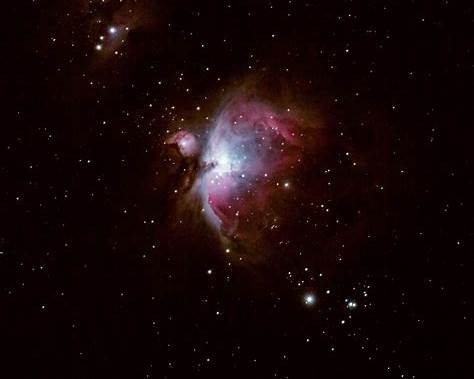
This Thanksgiving, I used my Celestron Origin Mark II home observatory system to photograph one of the most beautiful objects in the winter sky, the Orion Nebula. The image reveals the bright, glowing core of M42, a region filled with newborn stars and swirling clouds of gas and dust. It is one of

the most active and accessible stellar nurseries in our Milky Way.
I captured this view from my balcony, and the bright central region you see is illuminated by the Trapezium Cluster, a group of very young and extremely hot stars. Their intense ultraviolet light energizes the surrounding hydrogen gas, causing the beautiful red and blue glow that makes M42 so striking.
⭐ Star Formation Inside the Orion Nebula
The Orion Nebula lies about 1,350 light years from Earth and contains all the key stages of early star formation. Cold clouds of hydrogen slowly collapse under gravity, forming dense regions that heat up as they shrink. These growing cores eventually become protostars. When the temperature in the center becomes high enough, nuclear fusion ignites, and a new star begins to shine.
Around many of these young stars are protoplanetary disks, which are flat swirling structures of dust and gas. More than 180 of these disks have been observed in M42. They are the starting points for future planetary systems and provide clues about how our own Sun and planets may have formed billions of years ago.
🔭 A Moment to Remember
Taking this photo during Thanksgiving made the experience even more meaningful. While we celebrated on Earth, deep in the Orion Nebula entire solar systems were beginning to form. Capturing this process through my own telescope reminded me how dynamic and creative our universe truly is.

 SCIENCE WITH LARA
Leave a comment