Imagine waking up tomorrow to the biggest news in human history: an extraterrestrial spacecraft has landed on Earth.
After the first questions, Where did they come from? Why are they here? How do we communicate with them?, we might eventually encounter a
much more ordinary problem:
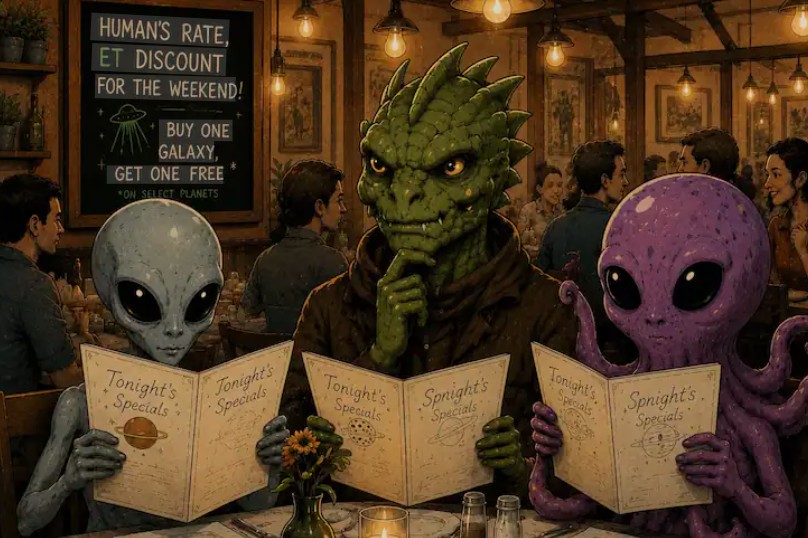
What do we offer them for dinner?
Pizza? Fruit? A bowl of pasta?
Or would the very idea of “food” mean something completely different to life that evolved on another world?
Of course, there is currently no scientific evidence that extraterrestrial beings have visited Earth, and we know nothing about what an alien organism might eat. So this is a thought experiment, not a prediction. But it turns out to be a surprisingly interesting way to explore some fundamental ideas in astrobiology, metabolism, and the chemistry of life.
How Many Calories Does an Alien Need?
Before deciding what an alien might eat, we could ask a simpler question: How much energy would it need?
Every known organism needs energy to maintain itself. Even while resting, animals use energy for processes such as circulation, cellular repair, nervous system activity, and, for animals that regulate their own temperature, thermoregulation.
For terrestrial animals, metabolic rate generally increases with body mass, but not in direct proportion. A commonly discussed relationship is Kleiber’s law, often approximated as:
B ∝ M3/4
where B represents metabolic rate and M represents body mass.
This means that larger animals generally require more total energy, but less energy per kilogram of body mass than smaller animals.
If we imagined an alien with physiology broadly resembling a warm blooded Earth animal, we could therefore make a rough estimate of its energy needs.
But its mass would be only the beginning.
Does it regulate its own temperature? How much does it move? Does it fly? What kind of gravity did it evolve under? How large and energy intensive is its brain?
A large brain could matter enormously. In humans, the brain consumes around one fifth of our energy at rest. So those classic science fiction aliens with enormous heads might have some serious energy requirements!
Could Aliens Actually Eat Earth Food?
Even if we knew how much energy an extraterrestrial needed, we still would not know whether anything in our refrigerator could provide it.
Earth life shares an interconnected biochemical history. Our cells use particular amino acids, sugars, lipids, enzymes, and metabolic pathways that developed through billions of years of evolution on this planet.
Alien life would have an entirely separate evolutionary history.
Even if extraterrestrial organisms were carbon based and depended on liquid water, their biochemistry might be sufficiently different that terrestrial proteins or sugars would be useless to them.
A plate of food could contain plenty of chemical energy and still provide zero usable nutrition if an organism lacked the biochemical machinery needed to process its molecules.
So an alien could theoretically look at a table filled with bread, fruit, vegetables, and pasta and find almost nothing it could actually eat.
Earth: The Most Dangerous Restaurant in the Galaxy?
There is another problem.
Earth food does not contain only nutrients. It can also contain microorganisms, allergens, toxins, and countless complex molecules.
An extraterrestrial organism would have no shared evolutionary history with Earth’s biosphere.
Would our microorganisms harm it?
Perhaps. Or perhaps terrestrial microbes would be completely incapable of interacting with alien cells.
We simply do not know.
The idea has an interesting science fiction precedent. In H. G. Wells’s The War of the Worlds, the invading Martians ultimately encounter something more dangerous than human weapons: terrestrial microorganisms.
In a real encounter with extraterrestrial biology, questions about cross contamination and planetary protection would therefore be extremely important. We would need to protect both Earth’s biosphere and whatever alien biology we encountered.
Maybe They Would Not Want Food at All
Perhaps we are asking the wrong question.
Instead of asking, “What food would aliens eat?”, maybe we should ask:
“What source of energy and matter would their biology require?”
Even on Earth, organisms obtain energy in remarkably different ways. Plants capture energy from sunlight. Animals consume other organisms. Some microorganisms obtain energy from chemical reactions involving inorganic substances.
An extraterrestrial organism might therefore be interested not in pizza or vegetables, but in water, nitrogen, phosphorus, iron, salts, simple organic molecules, or other raw materials.
And then there is an even stranger possibility.
What if an advanced extraterrestrial civilization were no longer entirely biological?
A synthetic or artificial intelligence might not require proteins, carbohydrates, or fats at all. Its “food” could be electricity, sunlight, chemical fuel, heat, or another source of usable energy.
Asking a robotic extraterrestrial what it wants for dinner might be a little like asking your laptop whether it prefers pasta or pizza.
What Would Alien Life Be Made Of?
This is where a funny question about alien food turns into a much bigger astrobiological question:
How much of Earth’s biology is universal?
Because Earth is currently our only confirmed example of a living world, almost everything we know about life comes from studying organisms that share the same planetary history.
But if life independently originated somewhere else, would it follow the same biochemical rules?
Would it use DNA to store information?
Would it build proteins from the same amino acids?
Would it require liquid water?
Would it use oxygen?
Would it even have cells or something we would recognize as a digestive system?
We do not yet know.
And that is one of the reasons I find astrobiology so fascinating. Searching for extraterrestrial life is not only about finding another organism. It forces us to ask a deeper question:
What does it actually mean to be alive?
Dinner With an Extraterrestrial
If intelligent extraterrestrials ever reach Earth, humanity would need astronomers, biologists, chemists, engineers, linguists, and probably many kinds of scientists we have not even thought about yet.
Apparently, we might also need some very adventurous nutrition scientists.
Before sharing a meal, we would have to determine what molecules the visitors could metabolize, what substances might poison them, what microorganisms they carried, and what resources they could safely use without harming Earth’s ecosystems.
Perhaps first contact would not begin with a dramatic declaration about humanity’s place in the cosmos.
Perhaps it would begin with a much simpler question:
“Are you hungry?” 👽🌎
References and Further Reading
José Miguel Soriano del Castillo, “If Aliens Landed on Earth Tomorrow, What Would They Eat?” The Conversation, republished by Phys.org.
José Miguel Soriano del Castillo, discussion of extraterrestrial nutrition, metabolism, bioenergetics, and the biochemical compatibility of terrestrial food with hypothetical extraterrestrial organisms.


Leave a Reply