What is the three-body problem, and why does it remain unsolved? Astrophysicists explain that systems with two objects under mutual gravitational attraction—like planets or stars—can be reliably
predicted. This two-body problem has been solvable since Isaac Newton’s era, enabling scientists to forecast the paths of such paired objects. However, the dynamics change drastically when a third body is introduced, leading to chaos.
The three-body problem states that when three bodies gravitate towards each other according to Newton’s law of gravitation, there is no general closed-form solution to describe their orbits. In these scenarios, even small variations can quickly escalate, resulting in chaotic and unpredictable outcomes.
For centuries, scientists have searched for an initial configuration of three gravitational bodies that could produce stable, predictable orbits. Although a comprehensive solution remains elusive, recent studies have suggested intriguing approaches, including models inspired by the random movements of intoxicated individuals.
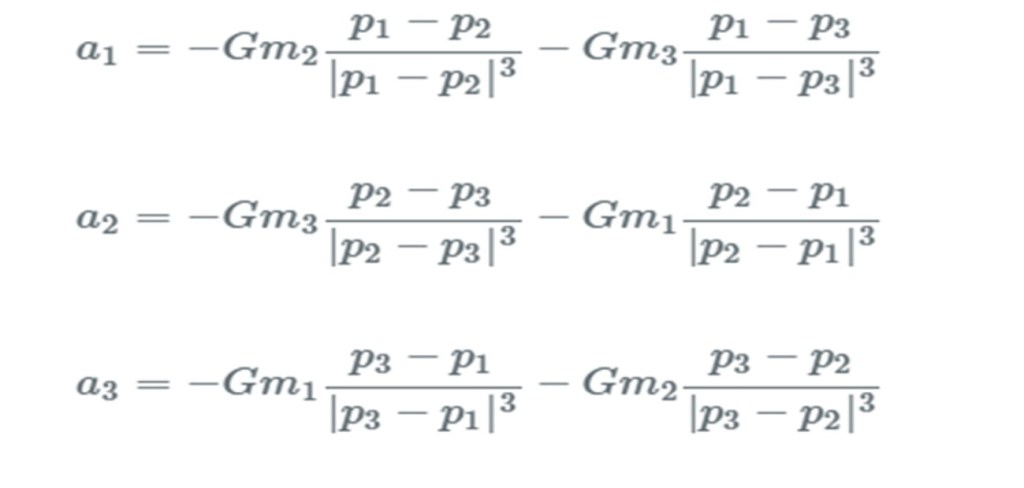
3Body problem can be formulated as shown on the right
Where G is the gravitational constant and pi=(xi,yi,zi) and ai refers to the acceleration of pi such as:
The three-body problem represents an unique instance within the broader n-body problem, where three objects interact through gravitational forces. Historically, the earliest extensively studied example of this problem was the gravitational relationship among the Earth, Moon, and Sun. Today, the term “three-body problem” has a broader application, describing any situation in classical or quantum mechanics where the motion of three particles is analyzed.
In Cixin Liu’s novel, The Three-Body Problem, aliens face a harsh reality as they inhabit a solar system with three suns. The gravitational tug-of-war among these three stars leads to a chaotic dance, disrupting the entire solar system as the stars pull and fling one another across space.
For the Trisolarans—the alien civilization in this world—this instability brings dire consequences. When one sun is flung far away, their planet plunges into a deep freeze, while another sun’s close approach scorches their world. Even worse, due to the unpredictability caused by the three-body problem, these devastating shifts are impossible to foresee. Recently, a TV series adaptation, called the 3 Body Problem, of Cixin Liu’s novel released on Netflix if you’re interested.
Universe Sandbox Legacy is an interactive space simulator that goes beyond the typical astronomy software, which usually just shows the night sky or planetary positions. Instead, Universe Sandbox is a robust gravity simulator that lets users experiment with cosmic scenarios—such as adding another star to our solar system to observe how it affects planetary orbits. As a physics-based space simulator, Universe Sandbox integrates gravity, climate, collisions, and material interactions to showcase the intricate complexity of the universe and the delicate balance of our own planet. It provides an immersive experience where you can create, destroy, and interact with celestial objects on an unprecedented scale.
Interesting, I hadn’t thought of the Sun, Earth and Moon that way. Do the three bodies have to be similar in mass, for their interactions to be chaotic?



 SCIENCE WITH LARA
Leave a reply to Lara Ertaul Cancel reply