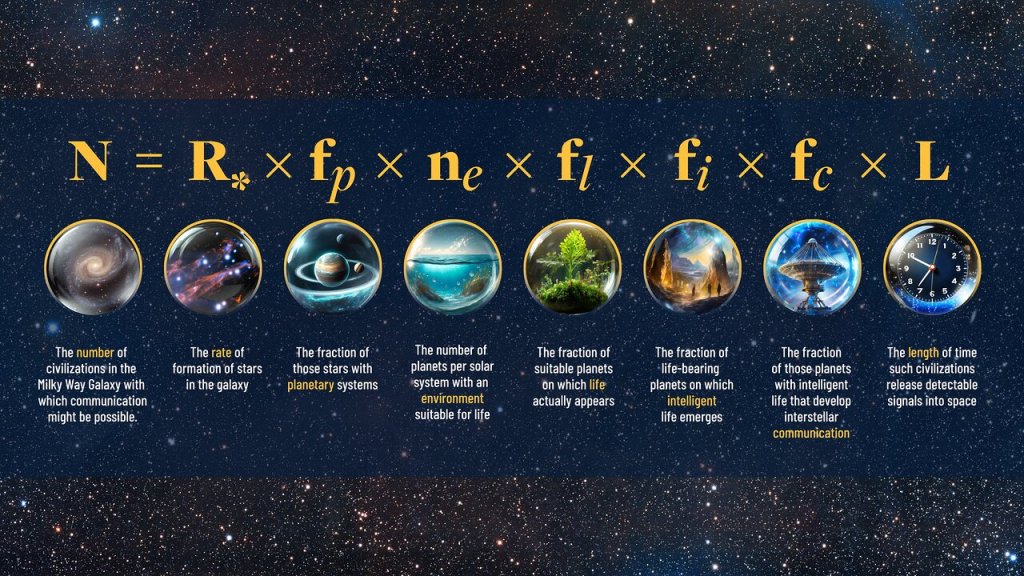
The Drake Equation is a probabilistic formula developed by astronomer Frank Drake in 1961 to estimate the number of active, communicative extraterrestrial civilizations in the Milky Way galaxy. Rather than providing a definitive answer, the equation serves as a framework to guide scientific discussions about the factors influencing the existence of intelligent life beyond Earth.
Where:
N = R* × fp × ne × fl × fi × fc × L
– N: The number of civilizations with which humans could potentially communicate.
– R*: The average rate of star formation per year in our galaxy.
– fp: The fraction of those stars that have planetary systems.
– ne: The average number of planets per star that could support life.
– fl: The fraction of those planets where life actually develops.
– fi: The fraction of planets with life where intelligent life evolves.
– fc: The fraction of civilizations that develop technologies detectable from space.
– L: The average length of time such civilizations release detectable signals.
Estimating the Probability of Life in the Milky Way
The Drake Equation itself doesn’t provide a single definitive probability due to the substantial uncertainty in each factor. Instead, it organizes our understanding and highlights uncertainties regarding extraterrestrial life.
However, astronomers often provide estimates for these factors to assess the likelihood of extraterrestrial civilizations:
- Star Formation (R*): Approximately 1–3 new stars per year in the Milky Way.
- Planets around Stars (fp): Observational data suggest nearly all stars have planets, so this factor is often near 1.
- Habitable Planets per Star (ne): Typically estimated between 0.2–2 planets per system.
- Life Arising (fl): Highly uncertain, ranging widely from nearly certain (1) to extremely rare (as low as 0.0001).
- Intelligent Life Emergence (fi): Speculative estimates range broadly from extremely rare to relatively common.
- Civilizations Communicating (fc): Could range from rare to common once technological capability is present.
- Communication Duration (L): The longevity of civilizations might range from hundreds to millions of years.
Thus, estimates for the number of technologically advanced civilizations range dramatically, from just one (ourselves) to potentially millions, reflecting the enormous uncertainty inherent in these factors.
Ultimately, the Drake Equation tells us that while life in some form could be relatively common, intelligent and technologically communicative life might be exceedingly rare or short-lived. Hence, our estimates remain speculative and deeply debated within the scientific community.

 SCIENCE WITH LARA
Leave a comment