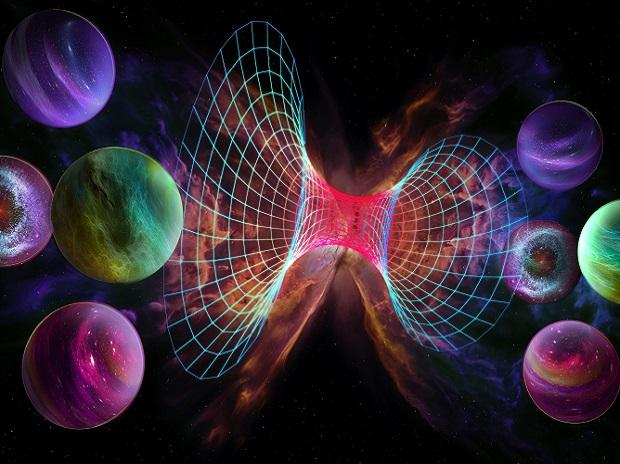
This post is based on a project that I completed and presented during the Columbia University Pre-College Program in the summer of 2025, under the guidance of Dr. Paul M. Sutter. The goal of the project was to explore one of the most profound and puzzling questions in cosmology: What, if anything, came before the Big Bang?
The Big Bang theory explains how our universe expanded from an extremely hot and dense state about 13.8 billion years ago. Yet even this well-established model begins with a mystery. Einstein’s equations of general relativity break down at the singularity where the Big Bang begins. At that point, gravity becomes infinitely strong, and the known laws of physics no longer apply. Because of this breakdown, there is no mathematical link between what may have existed before the Big Bang and what came after. Time and space themselves originated with that moment, making the idea of “before” extremely difficult to define.
Despite this challenge, scientists have proposed several fascinating theories that attempt to reach beyond that boundary. Each theory offers a different way to think about what the universe might have been, or how it might have behaved, before the beginning of time as we know it.
Cyclic Universes and the Big Bounce
One leading idea is the Big Bounce, which suggests that the universe may not have had a single beginning but instead experiences endless cycles of expansion and contraction. In this model, our current expanding universe will one day stop growing. As the effects of dark energy diminish, the universe could slow its expansion and begin to collapse under its own gravity. This collapse, called a Big Crunch, would shrink the cosmos to an unimaginably small size known as the Planck volume.
At that point, a remarkable transformation could occur. Instead of ending in a final collapse, the universe might rebound outward in a new phase of expansion, becoming another Big Bang in a repeating cosmic rhythm. According to Loop Quantum Gravity, this rebound marks a quantum transition in which the collapsing universe behaves like a black hole that transforms into a white hole. In this view, creation and destruction are part of the same continuous cycle, and every end becomes a new beginning.
Conformal Cyclic Cosmology
Another elegant idea comes from the physicist Roger Penrose, who developed the theory of Conformal Cyclic Cosmology, or CCC. This model envisions the universe as one link in an infinite chain of cosmic epochs, which Penrose calls “eons.” In each Aeon, the universe expands for trillions of years until all stars burn out and matter decays into pure radiation.
At that distant stage, only massless particles such as photons remain. Without mass, there is no longer a meaningful concept of distance or size. An infinitely large universe becomes equivalent to an infinitely small one. Through this strange symmetry, the universe effectively resets itself, and a new Big Bang begins the next aeon. According to CCC, our current universe was born from the final fading light of a previous one, and in the far future, our own universe will eventually give rise to another.

 SCIENCE WITH LARA
Leave a comment