JWST’s Little Red Dots and the Mystery of QSO1
One of the most exciting breakthroughs in astronomy in 2025 came from the James Webb Space Telescope (JWST) and a mysterious population of objects known as Little Red Dots. At first glance, these objects appear as tiny faint red points scattered across deep field
images. However, one object in particular called QSO1 has forced scientists to rethink how the earliest structures in the universe formed.
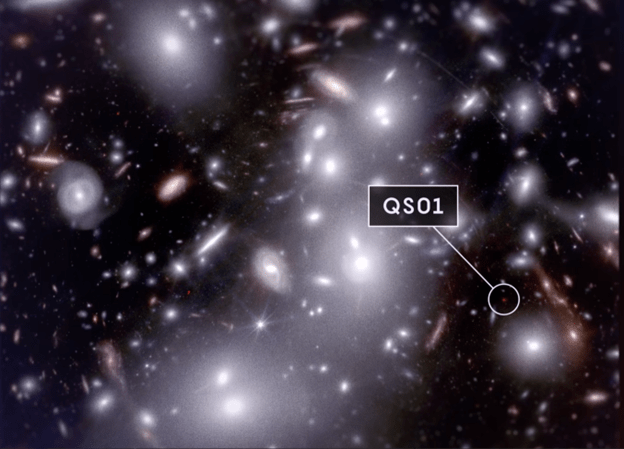
As seen in the deep field image of the galaxy cluster Abell 2744, QSO1 appears as a small red source embedded among much larger and more mature galaxies. Despite its compact appearance, its infrared brightness reveals that it is producing an extraordinary amount of energy. The light detected from QSO1 has traveled for more than thirteen billion years, allowing astronomers to observe it as it existed when the universe was less than one billion years old. Objects this small and energetic were not expected to form so early, making QSO1 immediately stand out.
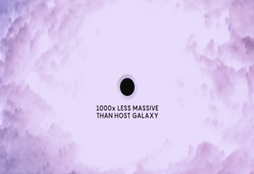
This unexpected behavior becomes even clearer when compared to the typical relationship between galaxies and their central black holes, as illustrated in the accompanying diagram. In the present-day universe, a supermassive black hole is usually about one thousand times less massive than its host galaxy. This relationship has been observed across countless galaxies and is considered a cornerstone of galaxy evolution. QSO1 does not follow this pattern. Instead, its black hole appears far too massive relative to the surrounding stars, suggesting that the black hole grew rapidly before the galaxy itself had time to fully form.
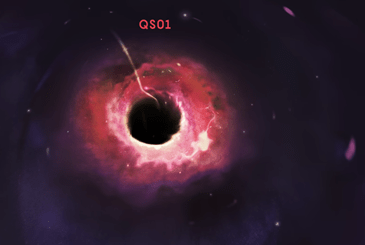
The physical nature of QSO1 is further illustrated in the visualization showing a rapidly accreting black hole surrounded by dense gas and dust. This material heats up and glows strongly in infrared light while obscuring much of the starlight that would normally
be visible. As a result, QSO1 appears red and compact in JWST images. This supports the idea that QSO1 represents an early phase of black hole growth rather than a typical quasar or fully developed galaxy.
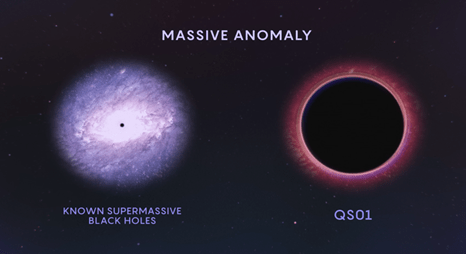
A comparison with well-known supermassive black holes in the nearby universe highlights just how unusual QSO1 is. In most galaxies, black holes are embedded within massive stellar systems and play a secondary role in the overall structure. In contrast, QSO1
appears dominated by its black hole, with little evidence of a large surrounding galaxy. This striking difference is why QSO1 is often described as a massive anomaly and why it challenges long held assumptions about the order in which black holes and galaxies form.
Together, these observations help explain the true nature of the Little Red Dots discovered by JWST. Rather than being small or failed galaxies, many of these objects are now thought to be early growing
black holes hidden within dense clouds of gas and dust. QSO1 provides one of the clearest examples of this newly revealed population and shows that black holes may have played a central role in shaping the earliest galaxies in the universe.


 SCIENCE WITH LARA
Leave a comment