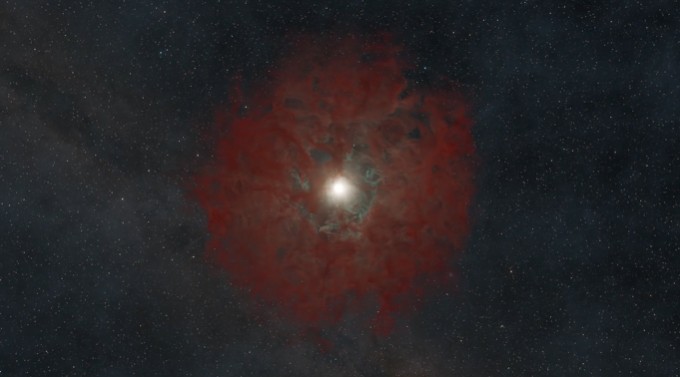
What if a massive star simply vanished?
Not in a brilliant supernova explosion.
Not in a cosmic blaze of glory.
But quietly.
Astronomers have just witnessed
exactly that.
A team led by Kishalay De at the Simons Foundation’s Flatiron Institute discovered that a luminous star in the Andromeda Galaxy disappeared without exploding. Instead of going supernova, the star’s core collapsed directly into a black hole.
This is one of the most complete observational records ever captured of a star transforming into a black hole.
The star, known as M31 2014 DS1, lies about 2.5 million light years away in Andromeda. For years, it was one of the galaxy’s brightest stars. Then in 2014, its infrared brightness began increasing. By 2016, it dimmed dramatically. By 2022 and 2023, it had essentially vanished in visible light, becoming ten thousand times fainter.
Only a faint mid infrared glow remains.
So what happened?
Massive stars normally end their lives in supernova explosions. When they run out of nuclear fuel, gravity overwhelms them. Their cores collapse, forming a neutron star. In many cases, neutrinos trigger a shock wave powerful enough to blast the outer layers into space.
But sometimes that shock wave fails.
Instead of exploding outward, most of the star falls inward, forming a black hole.
What makes this discovery even more fascinating is the role of convection. Gas inside the dying star was still swirling because of temperature differences between the hot core and cooler outer layers. When the core collapsed, this moving gas did not fall straight in. Instead, it began orbiting the newborn black hole, slowly feeding it over decades.
As material was expelled and cooled, it formed dust. That dust glows in infrared light, which is why telescopes like the James Webb Space Telescope can still detect a fading red signal long after the star itself disappeared.
This research, published in Science, helps answer one of the biggest open questions in astrophysics: Why do some massive stars explode while others quietly collapse into black holes?
We have known for decades that black holes exist. But we are still learning how they are born.
To me, what is most powerful about this discovery is that it reminds us how dynamic and unpredictable the universe is. Even something as dramatic as a star’s death does not always follow the script we expect.
Sometimes, the most profound transformations happen almost invisibly.
For more information about this discovery and the research behind it, visit:
https://www.simonsfoundation.org/2026/02/12/caught-in-the-act-astronomers-watch-a-vanishing-star-turn-into-a-black-hole/

 SCIENCE WITH LARA
Leave a comment