When we look up at the night sky, it feels eternal. The stars seem steady and permanent, as if they have always been there and always will be.
But cosmology tells a very different story.
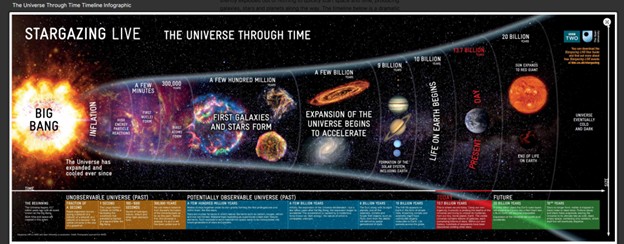
Scientists have outlined a possible timeline for the far future of the universe, stretching billions and even trillions of years ahead. It is both awe inspiring and humbling.
Here is a glimpse of what may happen:
• In 1 billion years
Earth will likely lose its oceans as the Sun gradually becomes brighter. Our planet will grow too hot for liquid water.
• In 4.5 billion years
The Sun will enter its red giant phase. It will expand dramatically and may engulf Mercury, Venus, and possibly even Earth.
• In 5 billion years
The Milky Way will collide with the Andromeda galaxy. Over time, the two galaxies will merge in a vast gravitational dance.
• In 6 billion years
The Sun will become a white dwarf, a dense stellar remnant that slowly cools in darkness.
• In 100 to 150 billion years
Cosmic expansion will push galaxies beyond our Local Group so far away that they disappear from our observable universe.
• In 450 billion years
The galaxies in our Local Group will merge into one massive galaxy.
• Between 100 billion and 1 trillion years
Star formation will gradually fade. The universe will produce its final generations of stars.
• Around 1 trillion years
Even the longest-lived stars will begin to die. No new stars will form, and the universe will slowly dim.
But Is That Truly the End?
That depends on dark energy, the mysterious force driving cosmic expansion.
If dark energy grows stronger, the universe could experience a Big Rip, where galaxies, stars, planets, and even atoms are eventually torn apart.
If dark energy weakens, gravity could reverse expansion in a Big Crunch, collapsing everything inward.
Or expansion may continue forever, leading to a slow fade into cold darkness, often called the Heat Death of the universe.
What fascinates me most is that we live in a very special cosmic era. Stars are still forming. Galaxies are visible. The universe is luminous and structured.
Studying astrophysics is not only about understanding how everything began. It is also about understanding how everything ends. And somehow, that makes this moment in cosmic history feel even more extraordinary.

 SCIENCE WITH LARA
Leave a comment