What does it really mean for gravity to bend light?
According to Einstein’s theory of General Relativity, massive objects such as stars and galaxies do not simply exist in space. They curve
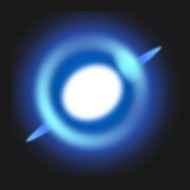
spacetime itself. When light from a distant galaxy passes near one of these massive objects, it follows that curvature and bends instead of traveling in a straight line. This phenomenon is called gravitational lensing, and it was first confirmed in 1919 when Arthur Eddington observed starlight bending around the Sun during a solar eclipse.
Astronomers later realized that entire galaxies and clusters of galaxies can act as powerful lenses. These cosmic magnifying glasses do more than brighten distant objects. They often distort them, creating arcs, multiple images, or even complete rings. In some cases, the magnification can be more than ten times, allowing us to observe galaxies that would otherwise be far too faint or distant to detect.
To better understand this, the following simulations illustrate how gravitational lensing changes depending on alignment and the mass distribution of the lens.
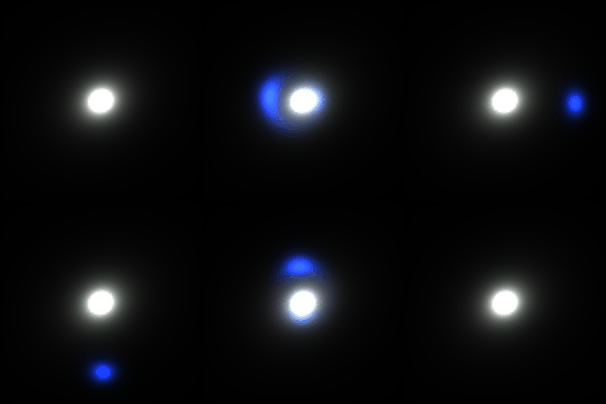
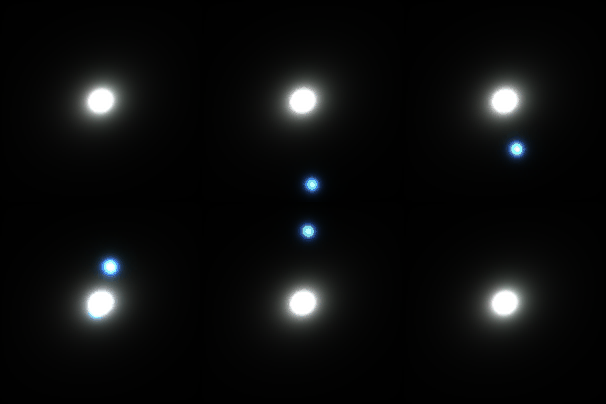
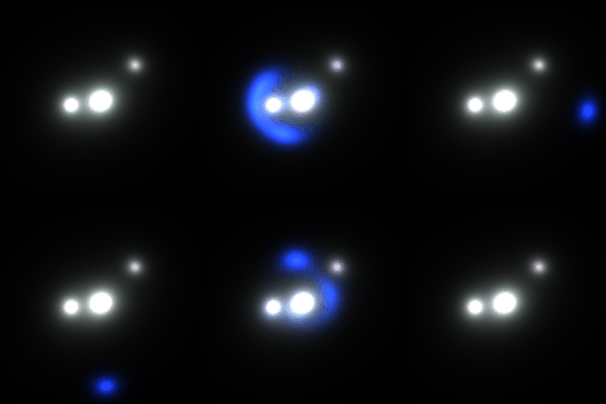
Figure 1. A distant background galaxy moves across a massive elliptical galaxy in the foreground. As the alignment changes, the light begins to bend slightly, demonstrating the early stages of gravitational lensing.
Figure 2. A distant background quasar moves across a massive elliptical galaxy in the foreground. The stronger lensing effect produces multiple images as light follows different curved paths around the lens.
Figure 3. A distant background galaxy moves across a galaxy group in the foreground. The configuration of the lensed images becomes more complex, showing how multiple galaxies can distort light in different ways depending on their arrangement.
Gravitational lensing is not only visually striking but also scientifically powerful. By studying how light is distorted, astronomers can determine how much mass is present and how it is distributed. This makes lensing one of the most important tools for mapping dark matter, which cannot be observed directly but reveals itself through its gravitational effects.
On April 21, 2026, a new citizen science project called Space Warps ESA Euclid was launched, inviting volunteers to help identify gravitational lenses in real telescope data. The Euclid Space Telescope, operated by the European Space Agency, is designed to map the large scale structure of the universe. Positioned about 1.5 million kilometers from Earth, it is observing billions of galaxies across more than a third of the sky, helping scientists understand how the universe has expanded over time and how dark matter and dark energy shape its evolution.
Finding gravitational lenses is challenging because they are extremely rare. Only about one in a thousand massive galaxies produces a strong lensing effect. Artificial intelligence has already analyzed tens of millions of galaxies and identified promising candidates, but many false positives remain. Human pattern recognition is still essential for recognizing subtle features such as faint arcs or unusual symmetry.
As a volunteer in this project, I have started exploring these images myself. Just today, I reviewed 125 objects. Most appear as faint points of light, but occasionally something stands out. A slight curve or a stretched arc can signal that light has been bent across billions of light years. These moments feel like discovery, even within a single image.
Projects like this show how astronomy is evolving through collaboration between scientists, artificial intelligence, and volunteers. By participating, volunteers not only help identify new gravitational lenses but also improve the performance of machine learning systems that search for them.
Gravitational lenses allow us to observe distant galaxies, study how structures form in the universe, and map the invisible distribution of dark matter. They give us insight into the expansion of the universe and the role of gravity on the largest scales.
And sometimes, all it takes is recognizing that a faint curve of light is not random. It is the result of gravity bending light across spacetime.
If you are interested in participating in real scientific research, there are many volunteer opportunities on Zooniverse.org. These projects make it possible to explore the universe not just by learning about it, but by helping to uncover it.


 SCIENCE WITH LARA
Leave a comment