Why I’m writing about this now
The 2026 Nobel Prize in Physics has brought new attention to the remarkable science of high-energy neutrinos and the IceCube Neutrino Observatory at the South Pole. The prize recognized Francis Halzen for his contributions to IceCube and the discovery of high-
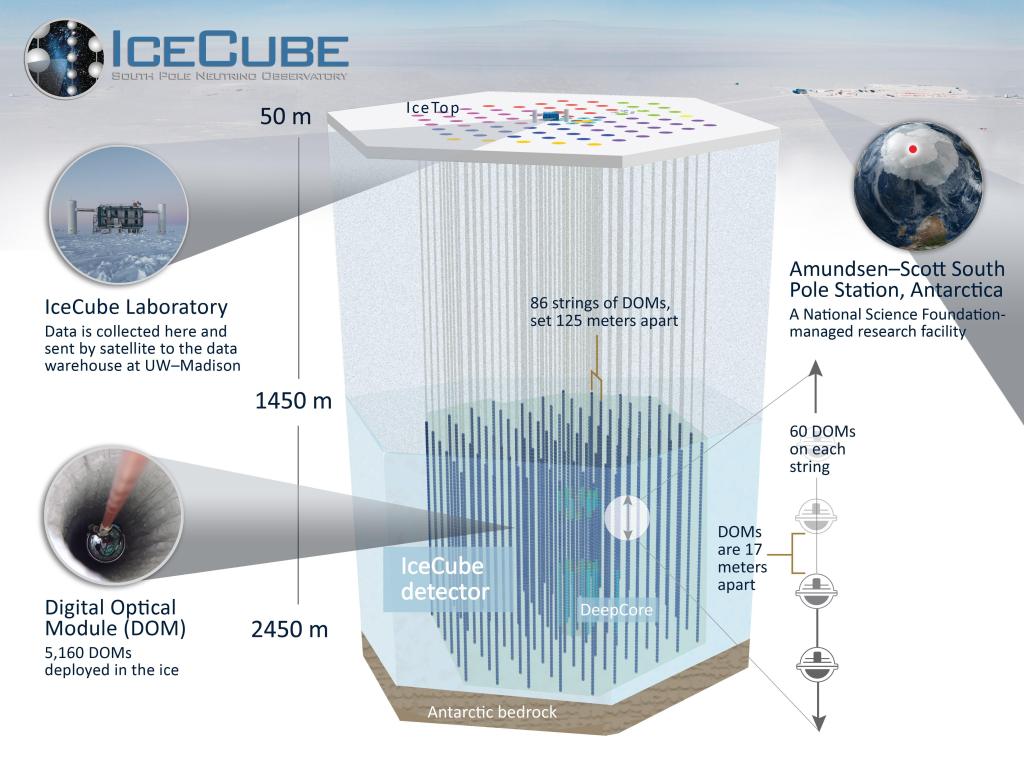
energy neutrinos from astrophysical sources. The announcement made me want to learn more about these mysterious particles—and how scientists can possibly detect something that passes through almost everything.
Imagine a particle traveling across the universe, passing through stars, planets, and even your body almost as though nothing were there. These particles exist. They are called neutrinos, and trillions of them pass through us every second.
Neutrinos are elementary particles with no electric charge and extremely small masses. Most importantly, they interact with matter only very rarely. This makes them extraordinarily difficult to detect, but it also gives astronomers an advantage: neutrinos can travel immense distances through the universe without being absorbed or significantly deflected. They can therefore carry information from places that may be difficult to study using light alone.
But how do you detect something that passes through almost everything?
Scientists built an extraordinary answer beneath the Antarctic ice: the IceCube Neutrino Observatory.
IceCube isn’t a conventional telescope. Instead of mirrors or lenses, it uses approximately one cubic kilometer of Antarctic ice as a particle detector. Buried between about 1,450 and 2,450 meters below the surface are 5,160 light-
sensitive Digital Optical Modules, arranged along 86 vertical strings.
The neutrinos themselves are not directly observed. Most pass straight through IceCube without leaving any trace. Very occasionally, however, a neutrino interacts with matter in or near the detector and produces a charged secondary particle. As that particle travels through the ice, it can produce a characteristic blue glow called Cherenkov radiation. IceCube’s sensors detect this light and record its timing and intensity. From the resulting pattern, scientists can reconstruct information about the particle—and ultimately estimate the direction and energy of the neutrino that produced it.
That means a particle that may have traveled across the cosmos can leave behind a tiny flash of light deep inside Antarctic ice.
This has helped create a new kind of astronomy: neutrino astronomy. Because high-energy neutrinos can originate in some of the most energetic environments in the universe, scientists can use them alongside observations of light, gravitational waves, and cosmic rays to investigate cosmic phenomena in different ways. This broader approach is known as multimessenger astronomy.
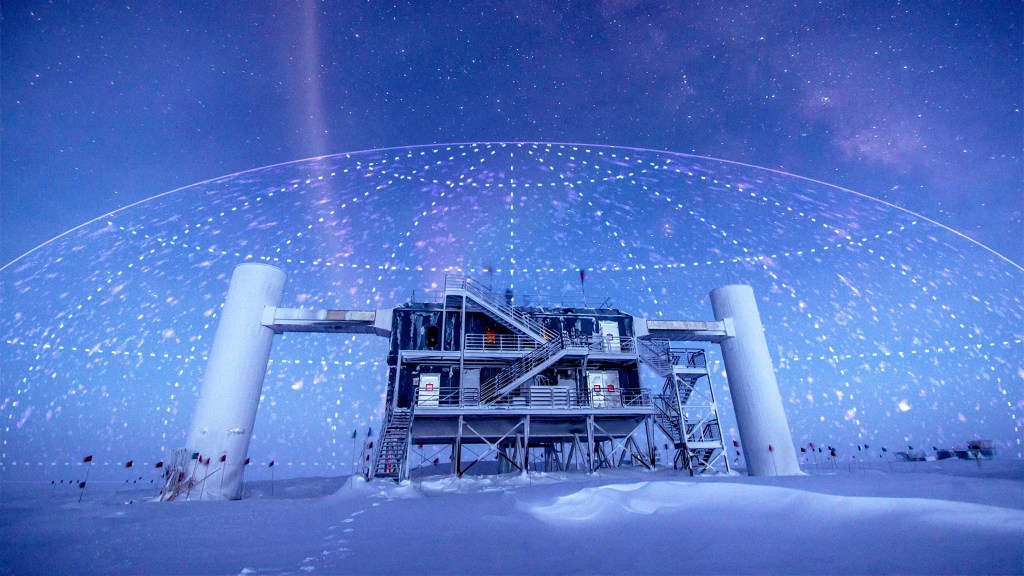
What fascinates me most about IceCube is that it changes our idea of what a telescope can be. We usually imagine looking upward through a telescope to understand the universe. IceCube does something almost opposite: scientists look deep beneath the surface of Earth, waiting for nearly invisible messengers from the distant universe to produce a tiny flash of blue light.
Learn More
Interested in exploring neutrinos and IceCube further?
- IceCube Neutrino Observatory — How IceCube Works
The official IceCube site explains the detector, its construction beneath the Antarctic ice, and how scientists use the light produced by neutrino interactions to determine neutrinos’ energies and directions. IceCube
Explore IceCube - IceCube Neutrino Observatory — Video
A visual introduction to IceCube and the science behind detecting neutrinos at the South Pole.
Watch the video on YouTube - IceCube Neutrino Observatory — YouTube Channel
Videos from the IceCube Collaboration about neutrinos, discoveries, the detector, and life and research at the South Pole.
Visit the IceCube YouTube channel


Leave a comment