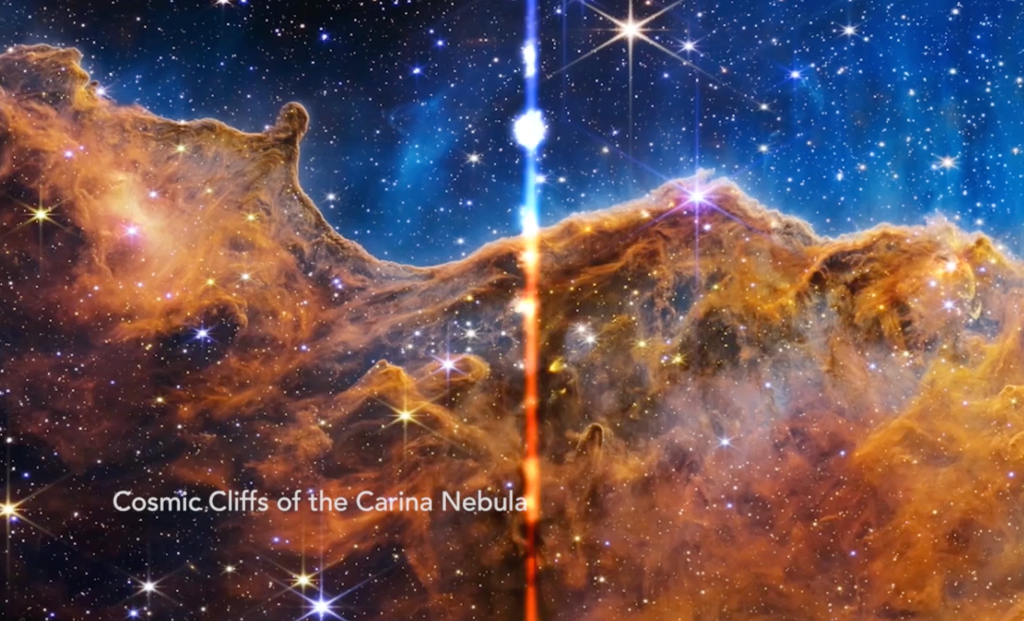
Sonification of the Universe
The universe is a vast, silent expanse, where sound cannot travel due to the absence of a medium like air or water. Yet, through an innovative process known as sonification, we can “listen” to the cosmos by converting astronomical data into audible sounds. This method translates attributes of celestial objects—such as brightness, position, and color into sonic elements like pitch and volume, effectively creating an auditory representation of the universe. Beyond its scientific and artistic value, sonification plays a crucial role in making astronomy accessible to visually impaired individuals, offering them a unique way to experience and explore cosmic phenomena.
The process begins with data collected by telescopes, which is typically presented visually as images. Sonification transforms these visual elements into sound by mapping specific parameters to corresponding audio characteristics. For example, the brightness of an object may determine the volume, with brighter areas producing louder sounds, while the position of an object in an image can be translated into pitch, where higher placements create higher tones, and lower positions correspond to deeper sounds.
This approach is more than just a tool for accessibility; it also enhances scientific understanding. By listening to sonified data, scientists can uncover patterns, trends, or anomalies that might not be immediately visible in traditional visual representations. Furthermore, the process often involves an element of artistry, as the choice of specific sounds and how data is mapped to them can create a rich and engaging auditory experience.
A prominent example of sonification in space exploration is the work done by NASA’s Chandra X-ray Observatory, which has produced numerous sonifications of celestial objects. For instance, high-energy X-ray sources within a galaxy are represented as high-pitched tones, while dimmer regions are conveyed through lower-pitched sounds.
The sonification process can be explored further through these video presentations.
NASA also provides a curated exploration of this innovation on its Plus portal, offering another perspective on how the universe is transformed into sound.
It is essential to note, however, that while sonification creates “sounds” of the universe, there is no actual sound in space. Sound waves require a medium to propagate, and the vacuum of space is devoid of such a medium. Sonification, therefore, is not a direct recording of cosmic events but rather an interpretive process that bridges scientific data and human perception.
By transforming silent, abstract astronomical data into a rich tapestry of sounds, sonification offers a novel way to experience the cosmos. It opens doors for scientific discovery, accessibility, and artistic expression, allowing us to connect with the universe in ways that transcend the limitations of sight and the silence of space.


 SCIENCE WITH LARA
Leave a reply to craftyfortunatelyc81d1bc093 Cancel reply