One of the things I love most about astronomy is that looking through a telescope is also a way of looking through both space and time.
Recently, I photographed the Dumbbell Nebula (Messier 27, or M27) using my Celestron Origin
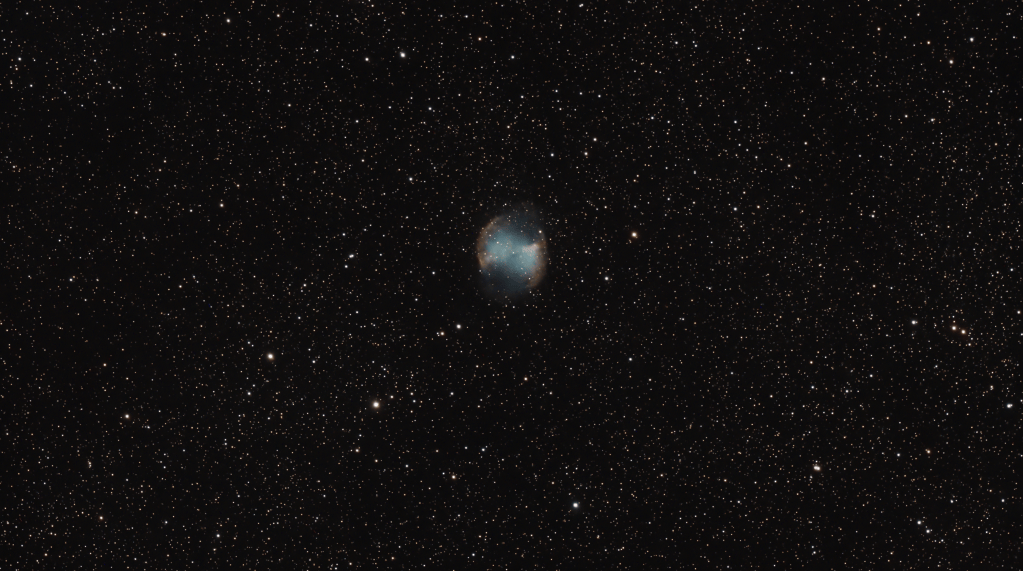
Mark II Intelligent Home Observatory. At first glance, it appears as a delicate blue-green cloud suspended in an enormous field of stars. But that faint cloud tells the story of the death of a star—and gives us a glimpse of what may eventually happen to our own Sun.
🌌 What Is the Dumbbell Nebula?
The Dumbbell Nebula is a planetary nebula located in the constellation Vulpecula, approximately 1,200 light-years from Earth.
Despite its name, a planetary nebula has nothing to do with planets. The term comes from early telescopic astronomy, when these small, rounded objects sometimes appeared vaguely planet-like through early telescopes.
M27 is also historically important. It was the first planetary nebula ever discovered, observed by French astronomer Charles Messier in 1764 and later included as object number 27 in his famous catalog.
Today, we know that M27 is something much more fascinating: the glowing remains of a dying star.
⭐ Watching a Star Reach the End of Its Life
For most of a star’s life, two forces are approximately balanced:
Gravity pulling inward ≈ Pressure pushing outward
Eventually, a Sun-like star runs low on nuclear fuel, evolves through its giant stages, and sheds its outer layers. The remaining core becomes a white dwarf, while the expelled gas can glow as a planetary nebula.
That makes M27 especially fascinating to me because our Sun is expected to follow a broadly similar evolutionary path billions of years from now.
When I photograph M27, I am therefore seeing more than a beautiful nebula. I am looking at a possible preview of the distant fate of our own star.
🔵 Why Does M27 Glow?
The hot central star produces energetic ultraviolet radiation that ionizes the surrounding gas. Different atoms then emit light at characteristic wavelengths.
Oxygen, hydrogen, nitrogen, and sulfur are among the elements whose emission can be detected in M27. In astronomical images, the exact colors we see also depend on the camera, filters, and image processing. NASA’s Hubble observations, for example, use different filters to distinguish emission from these gases.
This is one of my favorite ideas in astrophysics:
Light carries information.
By studying the wavelengths of light coming from an object, astronomers can learn about the composition and physical conditions of something more than a thousand light-years away.
⏳ Looking 1,200 Years into the Past
Perhaps the most amazing part of this image is something we cannot actually see.
M27 is approximately 1,200 light-years away.
That means the light captured by my telescope traveled through space for roughly 1,200 years before reaching Earth.
Since one light-year is about 9.46 trillion kilometers, the distance is approximately:
1,200 × 9.46 trillion km ≈ 11.4 quadrillion km
The photons recorded in my photograph therefore began their journey toward Earth around the 9th century.
So my telescope isn’t showing me M27 exactly as it is today.
It is showing me M27 as it appeared roughly 1,200 years ago.
🔭 How I Captured It
I captured M27 with my Celestron Origin Mark II, which uses a 6-inch Rowe-Ackermann Schmidt Astrograph (RASA) with a very fast f/2.2 optical system and a Sony IMX678 color CMOS sensor. Its fast optics are particularly useful for collecting light from faint deep-sky objects such as nebulae. The system captures successive exposures and stacks them to reveal more detail and color.
I find it incredible to think about what is happening during that process.
Light leaves a dying star, travels through interstellar space for more than a thousand years, reaches Earth, enters a telescope—and finally becomes part of an image.
🌠 Why I Keep Looking Up
This is why I love astrophotography.
At first, my photograph may simply look like a small blue-green cloud among thousands of stars. But hidden inside it are stellar evolution, nuclear physics, atomic physics, spectroscopy, and the immense scale of our galaxy.
And perhaps my favorite thought is this:
The light in this photograph began its journey more than a thousand years ago and ended its voyage in my telescope.
Every image of the night sky has a story. We just have to look closely enough to discover it.

 SCIENCE WITH LARA
Leave a comment