I photographed the Eastern Veil Nebula using my Celestron Origin Mark II Deep Space Observatory. Its delicate filaments stretch across a field of stars, forming a luminous arc with subtle hints of amber and blue-green. Looking at those wispy
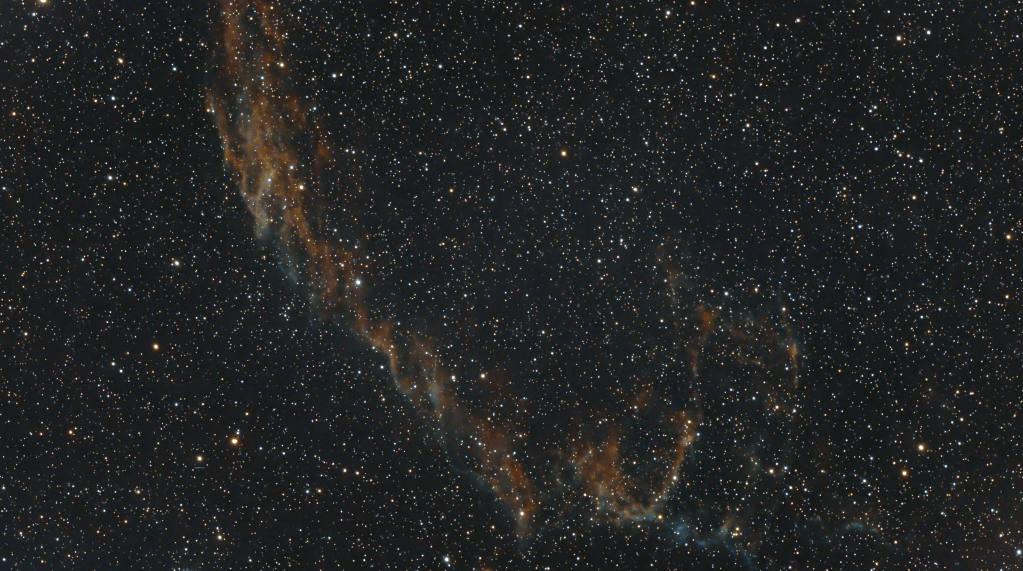
strands, it is hard to imagine the powerful explosion that created them.
The Eastern Veil is also known as Caldwell 33, and its bright regions are cataloged as NGC 6992 and
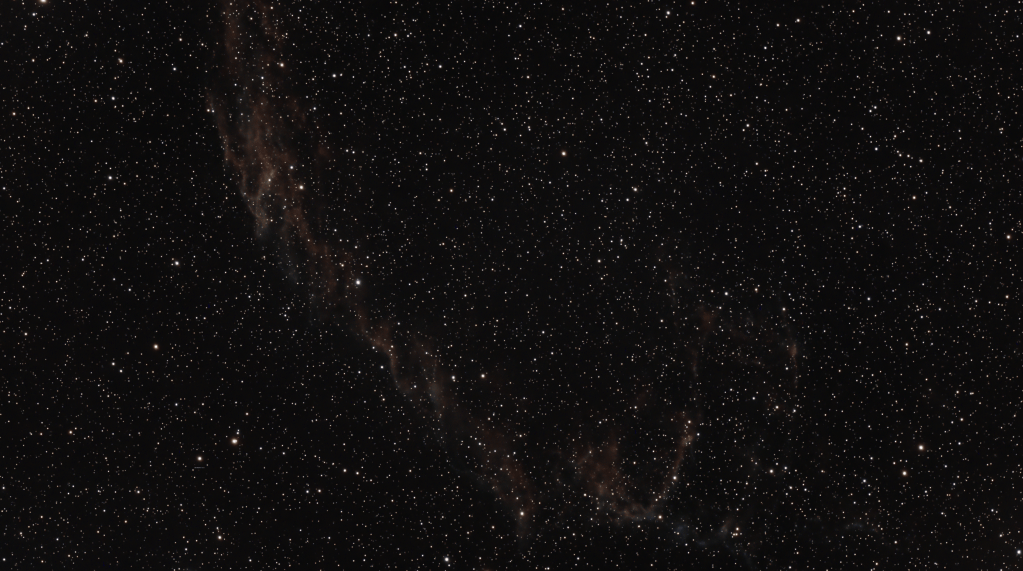
NGC 6995. It forms the eastern edge of the larger Veil Nebula, part of the supernova remnant known as the Cygnus Loop, in the constellation Cygnus—the Swan. It lies roughly 2,000 light-years from Earth, meaning the light captured in my photograph traveled for about two thousand years before reaching my telescope. NASA’s Eastern Veil guide
The scale is astonishing: the entire Veil Nebula spans approximately 110 light-years. The curved structure in my photograph is just one portion of that enormous remnant. Its delicate strands glow where the expanding blast wave encounters surrounding gas, creating shock fronts that heat and energize the material. Some of the sharpest filaments are thin sheets of glowing gas viewed edge-on. NASA explains the nebula’s structure
This story began when a massive star ended its life in a supernova explosion thousands of years ago—about 8,000 years ago, according to one NASA estimate. The explosion sent material outward into space, and the remnant continues to expand today. We are seeing the ongoing aftermath of that ancient event. NASA’s supernova overview
These two views of my photograph reveal different aspects of the nebula. The darker version shows its faint strands almost disappearing into the star field, while the brighter version brings more of its intricate structure into view. I love how each draws attention to a different detail in the same stretch of sky.
For me, that is part of the wonder of astrophotography: capturing light that tells a story far older than ourselves, and finding beauty in details our eyes alone cannot see.
Photography by Lara | Celestron Origin Mark II Deep Space Observatory


Leave a Reply