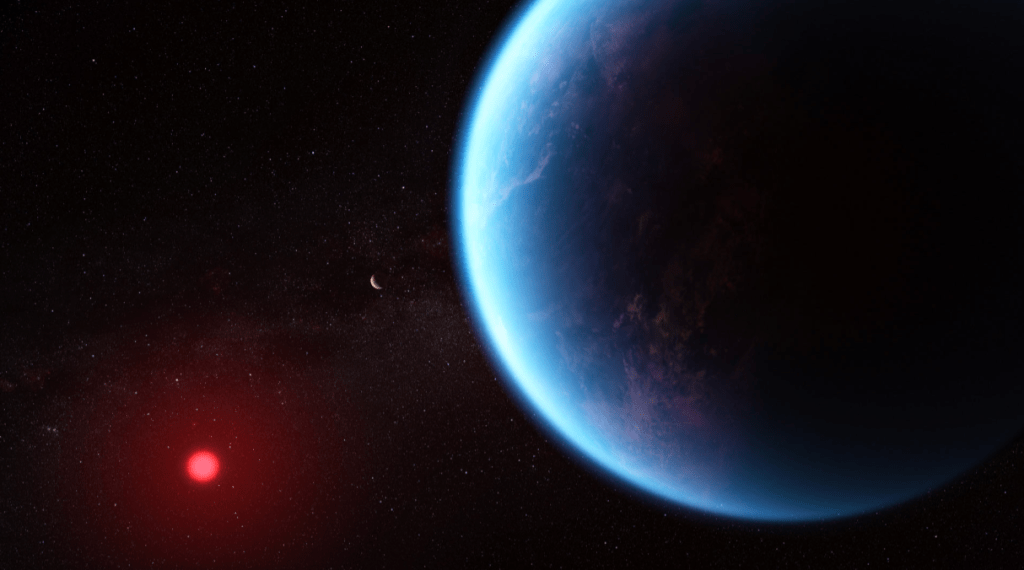
Roughly 124 light-years away in the Leo constellation lies K2-18b, a distant world first identified in 2015 through data from NASA’s Kepler Space Telescope. This exoplanet orbits a cool red dwarf star, K2-18, within its habitable zone, where conditions might allow liquid water to exist. With a mass about 8.6 times that of Earth and more than twice its diameter, K2-18b falls into a category of planets known as “sub Neptunes” or “super-Earths.” Past investigations, including those by the Hubble Space Telescope, revealed traces of water vapor in its atmosphere, pointing to the tantalizing possibility that this world could support life as we know it.
In a recent breakthrough, scientists from the University of Cambridge announced findings from the James Webb Space Telescope that show the presence of dimethyl sulfide (DMS) and dimethyl disulfide (DMDS) in the planet’s atmosphere. These molecules are especially intriguing because, on Earth, they are largely produced by marine life—suggesting they could be biological in origin. However, researchers emphasize caution, noting that these compounds might also arise from non-living chemical processes. While not definitive proof of life, this discovery marks one of the most promising leads yet in the ongoing exploration of life beyond our solar system.
For more detailed information, you can refer to the following sources:


 SCIENCE WITH LARA
Leave a comment